Health Harms
Tobacco use is responsible for approximately 7 million deaths every year, a preventable epidemic driven by industry profit. Millions more suffer from cancer, respiratory disease, and cardiovascular illness.
Making the Tobacco Industry Liable for the Harm It Causes
Tobacco use causes millions of deaths every year and imposes substantial costs on health systems, economies, and the environment.
Article 19 of the World Health Organization Framework Convention on Tobacco Control (WHO FCTC) provides the legal basis for governments to address tobacco industry liability, including compensation for harm.
For many years, Article 19 was mainly associated with litigation. Discussions among Parties have broadened this interpretation. Governments are increasingly examining administrative, fiscal, environmental, and other non-judicial mechanisms that can ensure the industry pays for the harms it causes.
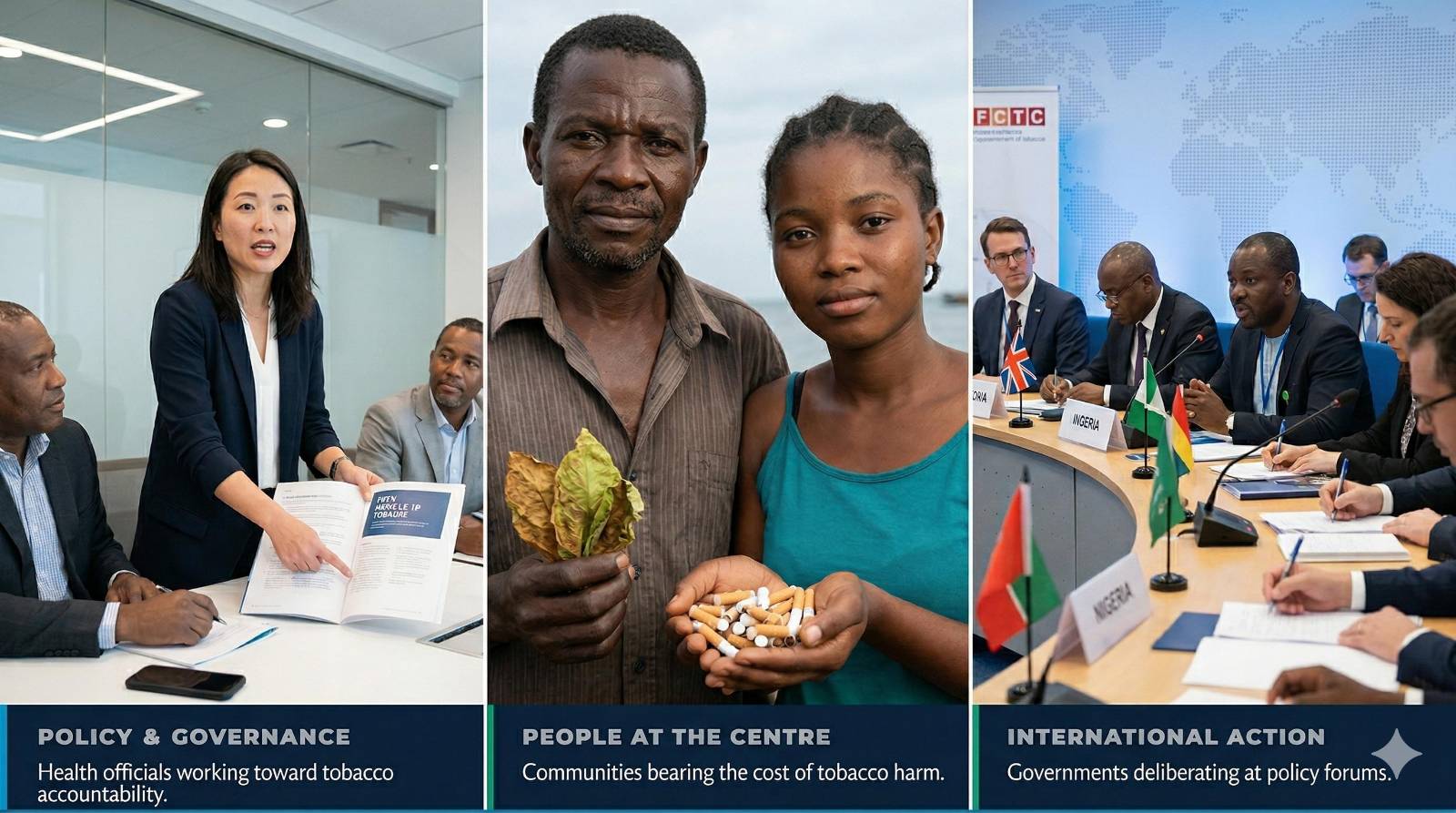
The evidence is clear: the tobacco industry causes widespread damage to people, communities, and ecosystems. Accountability mechanisms should reflect the full scale of that harm.
7M
deaths every year attributed to tobacco use globally
Across four critical dimensions health, environment, youth, and human rights the tobacco industry leaves a trail of destruction that demands urgent accountability from governments, regulators, and the global community.
Tobacco use is responsible for approximately 7 million deaths every year, a preventable epidemic driven by industry profit. Millions more suffer from cancer, respiratory disease, and cardiovascular illness.
Cigarette production and waste contribute to pollution, deforestation, and plastic contamination. Cigarette filters are among the world's most common plastic waste items found in ocean and land clean-ups.
Industry marketing practices deliberately target young people, engineering lifelong addiction before fully informed consent is possible. New products expand this reach globally.
Tobacco supply chains have been linked to child labour and unsafe working conditions in farming communities, disproportionately affecting the world's most vulnerable populations.
Why Accountability Matters
Holding the tobacco industry accountable is not only a matter of justice. It is essential to protect public health, restore environmental damage, and safeguard future generations from an industry that has prioritised profit over human life.
Find out all the other reasons for making tobacco pay
Learn moreWHO FCTC – Article 19
“...Parties shall consider taking legislative action...to deal with criminal and civil liability, including compensation where appropriate.”
Not limited to courts. Any mechanism a party considers appropriate falls within scope.
Track 1
Judicial track
Court-based proceedings
Track 2
Extrajudicial track
Beyond the courts
Both tracks can yield binding, compensatory outcomes and are not mutually exclusive. Strengthening who can bring claims also strengthens accountability across all mechanisms.
Civil society and victim capacity are cross-cutting enablers for both tracks, expanding who can bring a claim.
2) Mechanisms: how liability is imposed
Administrative / regulatory liability
Must be effective, proportionate, and dissuasive.
Legal obligations
Must be substantial enough to internalize harm.
Financial liability
Liability of polluters in environmental law: an example
Charge on harmful conduct, calibrated to harm cost.
Tax internalizing pollution costs. Paid upfront, not suspended by appeal.
Industry-funded clean-up pool. Covers costs even after bankruptcy.
Liability measures under Article 19 must not legitimize the tobacco industry’s misconduct or provide any benefit to the industry, including through mechanisms that could be used for corporate social responsibility purposes.
Article 19 of the WHO Framework Convention on Tobacco Control states:
“For the purpose of tobacco control, the Parties shall consider taking legislative action… to deal with criminal and civil liability, including compensation where appropriate.”
The interpretation and implementation of Article 19 have evolved over time through the Conference of the Parties (COP) to the WHO FCTC decisions and expert guidance.
Timeline note
The timeline below highlights the main legal and COP milestones that expanded how Article 19 is understood in practice.
May 2003
WHO FCTC adopted, establishing liability provisions
November 2016
Civil Liability Toolkit adopted.
February 2024
COP10 called to “(a) to apply to the tobacco industry the highest standards and best practices of holding businesses liable for their conduct;” and established the Expert Group to examine implementation of Article 19.
November 2024
Survey on implementation of Article 19 conducted.
May 2025
Expert Group report released, including administrative and non-judicial liability approaches.
November 2025
Parties encouraged to explore administrative liability and cost-recovery mechanisms
COP discussions also encourage Parties to draw lessons from other sectors, including the environment, human rights and regulation of business conduct.
COP10 “further requests the Convention Secretariat... (b) to participate in global fora to promote policy coherence between tobacco industry liability and the development of international law in relation to the environment, human rights and regulation of business conduct;..”
Canada’s tobacco restructuring arose after decades of litigation involving JTI-Macdonald Corp., Rothmans, Benson & Hedges Inc., and Imperial Tobacco Canada Ltd.
After the Quebec appeal judgment, the three tobacco companies entered CCAA insolvency proceedings in March 2019, triggering a stay and shifting the litigation into a restructuring and settlement process.
On March 6, 2025, Chief Justice Morawetz of the Ontario Superior Court sanctioned the CCAA plans, with a court-approved settlement amount of CAD$32.5 billion.
Implication for Article 19
Without pre-harm financial guarantees, bonds or insurance requirements, even a successful judgment can be rendered unenforceable through bankruptcy. Financial guarantees must be required before products enter the market — not after harm occurs.
Read more →The EU Single-Use Plastics Directive requires tobacco producers to cover the costs of collecting, treating and raising awareness about cigarette filter waste, operationalizing the polluter-pays principle.
Finland’s final law assigns operational responsibilities for tobacco-waste collection and public information to municipalities, limits producers to paying costs only, and entrusts cost-related decisions to an independent authority.
In France, by contrast, EPR implementation delegated operational responsibility to a Producer Responsibility Organisation co-managed by the tobacco industry eco-organization, allowing the industry to design and launch awareness campaigns.
Implication for Article 19
Any EPR or fee scheme that gives the tobacco industry a governance or implementation role becomes a CSR mechanism, not an accountability mechanism. Governments must ensure tobacco producers pay — and have no role in how the funds are managed or campaigns are run.
Read more →Article 5.3 and liability
Article 5.3 of the WHO FCTC requires Parties to protect tobacco control policies from commercial and other vested interests of the tobacco industry.
Several measures recommended in the Article 5.3 Guidelines support liability implementation.
Why it matters
Governance measures support implementation
These governance measures help ensure that liability mechanisms can be implemented effectively.
Article 5.3 measure
Relevance to liability
Facilitate documentation of industry conduct and damages
Article 5.3 measure
Relevance to liability
Prevent companies from using philanthropy to shield harmful practices
Article 5.3 measure
Relevance to liability
Avoid public financial support for tobacco industry activities
Article 5.3 measure
Relevance to liability
Protect institutions responsible for enforcement
Research paper
Data brief
COP10 briefing
Issue brief
These external resources complement the materials above with civil-liability tools, litigation references, institutional explainers, and accountability series from other organizations.
Toolkit
A civil-liability toolkit resource for tobacco control advocates and policymakers.
Open resourceInstitutional report
WHO expert group report on liability under Article 19 of the WHO FCTC.
Open resourcePlatform
An external roadmap resource focused on litigation, accountability pathways, and liability strategy.
Open resourceImplementation of Article 19 of the WHO FCTC: Liability Resources Package (2024)
Preventing Tobacco Industry Interference Toolkit (2023)
Accountability and Liability of the Tobacco Industry (2023)
WHO FCTC Conference of Parties Decisions (2014–2024)
WHO Framework Convention on Tobacco Control (2003)
Physicians for Smoke-Free Canada timeline of tobacco litigation (2014)
U.S. Department of Justice litigation against tobacco companies (2000)
Public Health Law Center explainer on the Master Settlement Agreement (1998)
GGTC webinar on non-traditional liability pathways under Article 19
This webinar explores how the health sector can engage with Article 19 beyond traditional litigation, including administrative, fiscal, and other liability-related approaches. It is a useful entry point for policymakers, advocates, and institutions tracking the shift toward broader liability implementation.
Open webinar page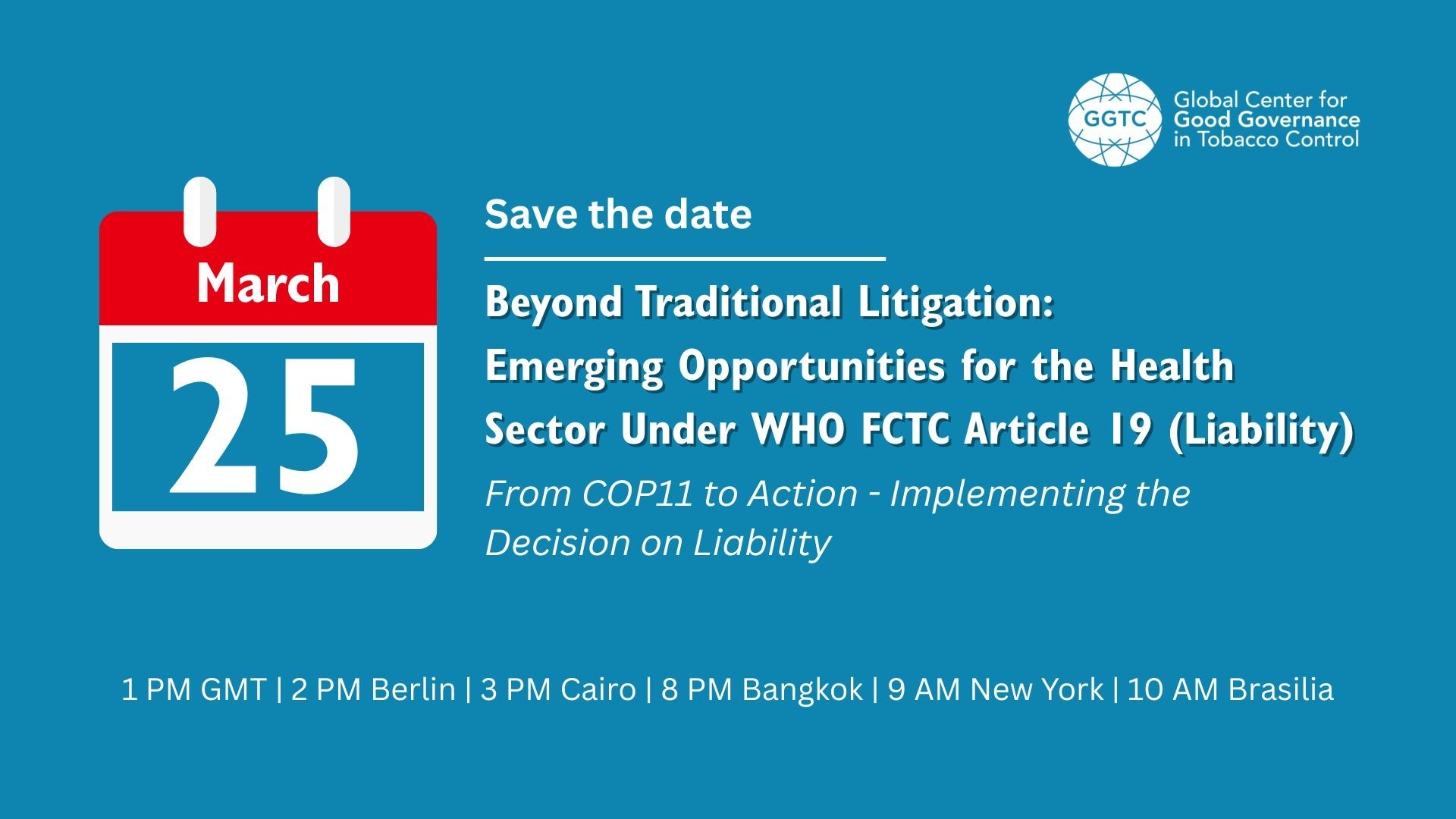
Webinar focus
A practical look at how Article 19 can support emerging accountability pathways beyond court-based litigation.